Entry-level producers are often confused by the "secret code" of letters and numbers in Texas Longhorn ID systems. In 2026, no key exists to decipher all the garbled words, numbers, and codes that are supposed to identify an animal. If you read this essay, however, you can decide whether or not such a cryptic puzzle makes any sense.
A prefix is a letter or group of letters added to the beginning of a root word to change its meaning. A suffix is added to the end of a word to alter its meaning or grammatical function.
~~The first and oldest prefix for Texas Longhorn brands is WR—the “holding brand” from the 1930’s of the Wichita Mountains Wildlife Refuge. The rest of the brand was an Identification Number (ID). (Numbering is not very original, but the government is not known for creativity.) That format of brand-plus-number was the registered name of every Wildlife Refuge critter, such as WR 4356. Something above 10,000 cattle have been branded with WR, making it the best-known prefix code for Texas Longhorns. But unless people know what WR stands for, that prefix is like winking at a lady in the dark—only the winker knows what it means.
~~The same discombobulation holds for suffixes at the end of a brand, like HR in Rebel HR. The final two letters identify the breeder as Harrell Ranch. Likewise, ECR in Cornerstone ECR identifies El Coyote Ranch, if you know what the initials stand for.
Suffixes and prefixes are a matter of choice. If you’re Googling, they can help locate an animal—but not easily. Most folks might recall a great bull’s popular name, but they don’t remember the initials in his prefix or suffix. For instance, the famous WT Kid Rock isn’t Kid Rock. Instead, he’s listed by only his official full name, which includes the prefix WT.
These details can be hard to remember. They tend to quickly get complex and aggravating, so people sometimes just leave off the prefix or suffix. Eventually, official names get shortened. For instance the famous bull that is officially JP Rio Grande is typically referred to as Rio, an unofficial name that is shorter, more convenient, and much easier to remember.
~~In Europe, governments control cattle registrations and have taken big bites out of producers’ profits. Often they require registration inspections, DNA PV, and even quotas of how many cattle a producer can maintain. Curiously, European regulations mandate an ear tag, because fire brands are considered inhumane. (Objections to fire-branding deserve another article, but remember that any branding pain is brief and literally superficial.) Ironically, a bunch of permanent holes punched in the ears is considered okay.
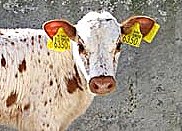
European registered Texas Longhorn
~~Back in the U.S., the original Santa Gertrudis Association gave a unique Private Herd (PH) number to each member/producer. The first PH number—No. 1—went to the King Ranch, because it had founded the breed. Thereafter, every registered critter from member ranchers was hot-iron branded with its own ID number plus a PH number designating the herd that animal came from. Each registered Santa Gertrudis thus carried its owner’s holding brand plus separate ID and PH numbers. As the association expanded members, its PH number grew so long it was finally discontinued.
~~Electronic identification (EID or RFID) ear pins have begun to replace or combine visual tags with digital data. They use radio frequencies to provide 15-digit, scannable identification for cattle. These high-tech tags are generally applied with specialized electronic or manual devices and identify the animal until it dies—or rips them out. They improve traceability for the IRS and for inspectors who enforce government regulations.
This kind of identification isn’t cheap or permanent. An EID applicator-and-computer system costs several hundred dollars. Although the pins are supposed to be permanent, some cattle lose them. More important, rustlers love them because they can be removed and replaced into different cattle. Besides, tiny numbers on a little round pin are hard to read at a distance in the field. Also, most commercial and registered ranches dislike EID’s because they make surveillance easy for the government, and they are far more costly than a hot iron brand.
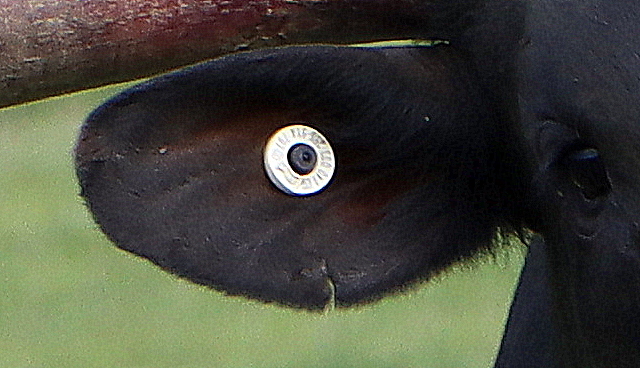
Cattle rustlers love the government EID pins.
~~Tattoos. Some registries require an inner ear tattoo for identification (ID). This is not as worthless as an EID pin, but equally or more so difficult to read, and it is not permanent. If the tattoo is well done, with abundant die, it will be easy to read for a few years, yet if a cow has good longevity it will fade and at some period be impossible to read. At best, with time, one or more tattoo digits will be impossible to see.
~~Freeze brands are beautiful on solid red or black cattle when professionally administered. When placed on cattle with a lot of white freezing is not as readable as fire brands.
~~Numbered ear tags are used a lot, however only the person who applies the tag knows the secret code that interprets what the numbers mean
~~Dickinson Cattle Co is old fashioned. When a calf is born a plastic tag is placed in the ear (pink for heifers—blue for bulls) with the name of the dam and the initials of the sire. At a glance, before they are old enough to brand, they have a visual ID. When they are registered the birthday tag is removed and the registered name is placed on a new tag with the initials of the sire right above. The new tag goes in the same ear-hole as the birth tag to prevent additional pain, and with blood, there is always a chance of some infection.
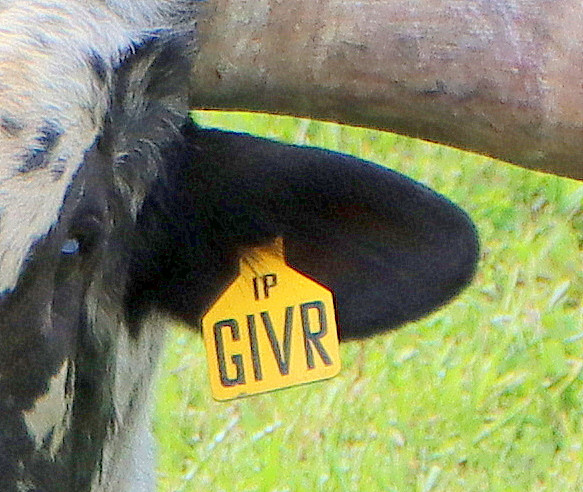
DCC Plastic Ear Tag
~~At weaning, each calf is fire-branded with the DCC holding brand on the right rib and an ID number on the upper-right hip. Right below the ID brand is the final digit of the year of birth—this year, it’s “6” for 2026. A fire brand is a permanent ID that’s easy to see anywhere. Even at the processing plant years later, it will show on both sides of the removed hide.
Every critter bred and raised at Dickinson Cattle Co displays the same brand system. If someone says, “I have a Dickinson animal,” it will have an easily visible registered holding brand and its own ID and birth numbers. If it doesn’t have these simple markings, it’s not a “Dickinson” animal. There may be a DCC ancestor back in the pedigree, but unless a Texas Longhorn is packing this paint brush D, it’s not “Dickinson.”
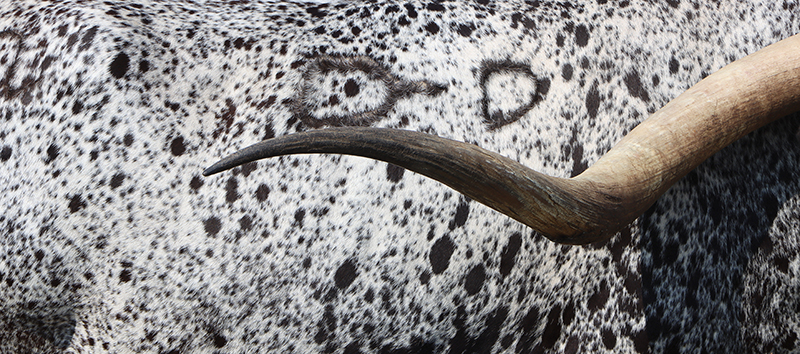 Dickinson "Paintbrush D" Holding Brand