Over 400 articles are posted on www.texaslonghorn.com. They include free information on producing cattle profitably. When a problem keeps hitting the fan, I do an article dealing with the issues. Better yet, I find an article someone else has labored over. Serious producers can read these eNews articles and save themselves a lot of heartache on a lot of topics:
Today’s topic: A new bull goes with the cows, but no calves are born in the expected time. The first-blush theory is "the bull is a dud." Not any different from an unwanted teen pregnancy after the senior prom---it’s always the boy's fault. At Dickinson Cattle Co, we sell over 70 bulls a year. In the last three years, 10 different clients have called claiming that their DCC bulls were not breeding cows. When we get that kind of assertion about virility, we replace the bull with one of equal value. For 9 of those recent replacements, the returned "dud" bulls were well fed, with good minerals for two or three months. Back at DCC, fertility tests showed that 9 of the bulls were satisfactory breeders. Then they went back on the DCC price sheet with a veterinarian’s semen test guarantee. Only one of those ten bulls failed the test. The other nine have functioned well for their new owners.
Let’s draw a defining line about guarantees. The buyer of a virgin bull rightly expects virility and agility. However, it’s impossible for the producer to control the bull’s management under new ownership. Things happen which are not the producer’s responsibility—and that fact can cause major misunderstandings that lead to contention.
Here’s an example. I once sold a bull who the buyer said would not breed, so I replaced him. Later the hired man informed me that the bull had tried to leap a fence and got his package caught in a high-speed discombobulation. As producer, I can’t control the new owner's poor fences---that’s totally about management.
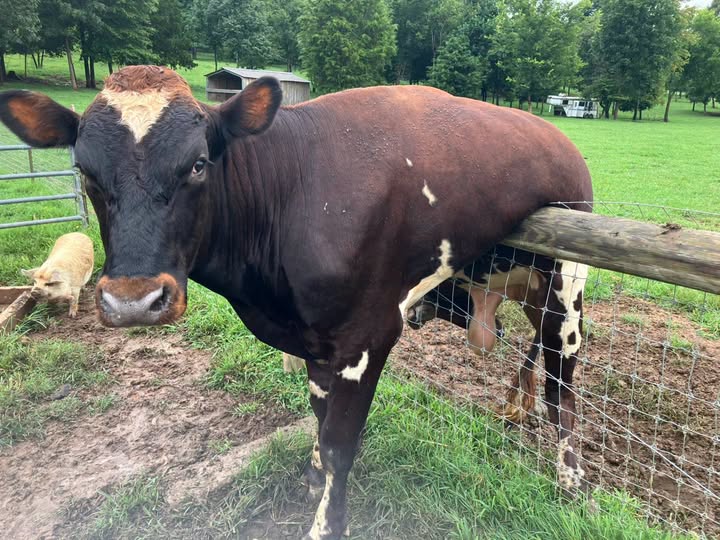
It is easy to believe this bull may have broken something rendering him infertile.
FERTILITY TESTING: The most common method of testing bull fertility is electroejaculation, which is available from all large-animal vets. Basic evaluations are "Satisfactory breeder," "Questionable," or "Unsatisfactory breeder." Statistically, one in ten fertile bulls is judged Unsatisfactory. Many owners would immediately sell that bull. But the Unsatisfactory label doesn't necessarily mean that he’s a non-breeder. It can be caused by test-procedure error or failure to collect a good specimen. A bull may be tested Unsatisfactory and still be totally virile.
CLOSED HERDS: A closed herd accepts new cattle only after serious health tests. Safe production calls for buying cattle only from closed herds with good health programs.
Buying many cattle from different sources is inevitably going to bring some reproductive disease into the herd. The more new cattle coming into a herd from different herds, the more disease can increase. It’s just a matter of time and numbers. Even if only the lead bull or a single cow has a "bug," it’s a strong bet the whole herd will get it. Herds not vaccinated for reproductive diseases are even more at risk. No matter how hard the bull works, the females won't get bred. It’s not his fault.
BULLYING: A young bull may find it hard to breed if bigger cows or big steers fight him off the cycling cows. A bigger, adult bull won't be intimidated, but young bulls may get hammered by "territorial defenders" or cystic cows with nymphomania. If a youngster gets bullied enough, odds are that he won’t breed many cows.
CLIMATE ADJUSTMENT: Cattle grow hair to be warm, and they shed hair to disperse heat. Ideally, producers move cattle from south to north in May, then in the fall from the northern states to southern states. This habitat change gives them time to acclimate. Slow, easy adjustment always helps with health and sometimes fertility.
June Cohron, DVM, of Stuarts Draft, VA, is an ITLA-approved judge. She says, “One normal occurring scenario of a bull not getting the job done is heat stress. A bull can be moved from a high elevation northern ranch and transported to a southern location and cause abnormalities developing sperm. Also a sickness or any high fever can disrupt or minimize conceptions.”
WEIGHT LOSS: good health and holding—or even gaining—weight during breeding seasons is good for a bull’s fertility. But weight loss may reduce semen quality. Good feed for herd sires is absolutely imperative, including a careful mineral program and adequate grass. So, too, for cows, because their body condition affects conception. Most conceptions occur in late spring or summer when rich new grass is bursting and females are increasing in body flesh. This is the optimal time for conception. Alternatively, when snow is flying, cattle are losing weight and conception is minimal. But too much of a good thing isn’t good: at the end of their show careers, very fat heifers are often difficult to breed or never breed due to excessive fat buildups in their reproductive systems.
SUPPLEMENTS: Salt blocks are commonly used in cattle operations to provide one crucial nutrient, NaCl. Unfortunately, they’re also responsible for myths and misconceptions that ultimately hold animals back. Cattle like salt, but some producers mistakenly believe that salt blocks provide enough trace minerals. Also, most salt blocks do not contain the variety of different minerals that cattle need for health and fertility. Relying on salt blocks as your herd’s main source of essential trace minerals is economical—but frugality may reduce conception, especially if a block contains less than 1% of trace minerals. Look at the label. (Messing With Minerals.)
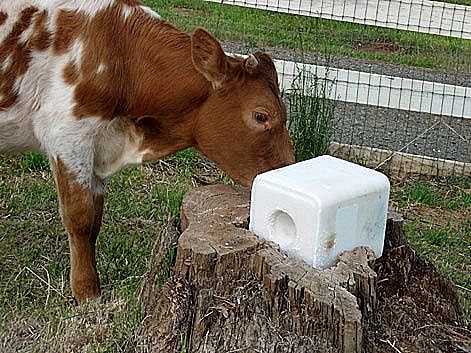
White salt blocks typically have less than 1% of necessary trace minerals. Producers feeding salt blocks could well be missing several calves a year if the supplements lack vitamins and minerals necessary for healthy conception.
Soil and mineral scientists are serious advocates of soil testing for a balance of added minerals that the soil doesn’t provide naturally. Both cows and bulls can experience reduced conception—or skip breeding completely—if they are not fed a year-round balance of both major and minor minerals.
Essential major (macro) trace minerals are calcium, phosphorus, chlorine, magnesium, potassium, sodium, and sulfur.
Essential minor (micro) trace minerals are copper, chromium, cobalt, iodine, iron, manganese, nickel, molybdenum, selenium, and zinc.
These minerals function as structural components of bones and teeth, electrolytes in body fluids, metabolism of nutrients, nerve conduction, reproduction, immune response, and many more functions. An unbalanced mineral program can cause even the most fertile male and female to fail to breed or carry a calf to term. Knowing what is lacking in the soil is the first step in correcting the balance with a well designed trace mineral.
The Bible identifies a process that creates a problem for cattle: “… the earth shall wax old like a garment” (Isaiah 51:6). For thousands of years, plants have sucked nutrients from the soil, and no one can afford to replace them in their original perfect form. So the most efficient process for sustainability is to feed livestock essential minerals in a studied mix.
Final example: Brian and Mary Stahl of Rockwood, PA, raised a promising young bull. He was breeding normally until he developed foot rot. With treatment, he recovered and became sound but was unable to settle a cow. A veterinarian did the normal fertility test, found that he produced almost zero live sperm, and recommended he be processed for burger. He was hauled to Ohio State University where veterinarians determined that he had acquired an infection during the foot-rot stress and that the infections had settled in his testicles, rendering him sterile. Their professional recommendation: process him for burger.
This young bull was so important to the Stahls, however, that they hoped for the best and did not follow the professionals’ advice. They fed him well, gave him time to recover, and placed him with cows. In due season, he recovered total fertility, semen was collected and his calves started to be born all over the pasture. That bull was Mr. Big Stuff. One of his sons is now known as WT Kid Rock. That is a happy ending.